What to Consider Before Buying Voluntary Health Insurance?
8 Key Factors Explained

Get a Quote and Details

Please leave your contact details and we will get back to you today or on the next business day. You may also call us at 25175860. *Required

I have read and understood the Personal Information Collection Statement.
By clicking "Submit", I agree to Bupa using my personal data to provide me with marketing information relating to insurance products, subscription plans and related services.

Voluntary Health Insurance is More Than Just a Tax Deduction

For many people in Hong Kong, one of the first reasons that comes to mind when buying medical insurance is tax deduction. However, the real value of the VHIS goes beyond tax savings. It is designed to help you answer an important question: if you wish to use private healthcare services, shorten waiting times, or have clearer inpatient protection, do you have medical coverage that you can rely on in the long run?

Launched in , VHIS is a government-certified individual indemnity hospital insurance scheme. Certified VHIS products are generally classified into "Standard Plans" and "Flexi Plans". Standard Plans follow a broadly standardised product design, while Flexi Plans build on the standard coverage by offering higher benefit limits or broader protection.

As of , government data showed that the number of VHIS policies reached approximately 1.341 million. Around 97% of these policies were Flexi Plans1, suggesting that many policyholders prefer higher levels of protection or more flexible coverage options.

3 Key Figures:
Why Are More People Looking into VHIS?

~1.341M
VHIS policies

As of , there were approximately 1.341 million VHIS policies. Among insured persons, around 53% were aged below 40, while around 12% were aged 60 or above1.

HK$8,000
Max. tax deduction per insured person per year

Taxpayers who purchase eligible certified VHIS products for themselves or specified relatives may claim tax deductions on qualifying premiums. From the 2020/21 year of assessment onwards, the maximum deduction is HK$8,000 per insured person each year, with no cap on the number of specified relatives.

152%2
Variation in private healthcare charges

A Consumer Council study highlighted issues around price transparency in private healthcare. For example, charges for an inpatient haemorrhoidectomy ranged from HK$33,881 to HK$85,387, representing a difference of 152%2.

Bupa VHIS Series

Bupa Hero VHIS provides full cover for eligible expenses up to HK$40 million per year.
No lifetime benefit limit, providing you with extraordinary cover that goes above and beyond

8 Key Factors to Consider Before Buying VHIS

1.Do You Need Basic Protection
or Higher-Level Coverage?

VHIS products are mainly divided into two categories: Standard Plans and Flexi Plans. Standard Plans meet the government's minimum product requirements and are broadly similar in design. Flexi Plans, on the other hand, provide higher benefit limits, broader coverage, or additional benefits on top of the standard protection.

If you are mainly looking for basic inpatient protection, a Standard Plan may be easier to compare. However, if you want more comprehensive protection for private hospital stays, surgery, cancer treatment, or potentially high medical expenses, you should compare the annual benefit limits, deductible options and full-cover arrangements under different Flexi Plans.

Data point: As at the first quarter of 2024, around 97% of VHIS insured persons had purchased Flexi Plans1, suggesting that many consumers may consider basic protection alone to be insufficient.


Comparison of VHIS Standard Plan and Flexi Plan
Annual benefit limit and private healthcare expenses

2.Is the Annual Benefit Limit Enough
for Private Healthcare Expenses?

When buying medical insurance, it is not enough to ask whether a policy provides reimbursement. You should also check how much it may reimburse. The annual benefit limit of a Standard Plan is generally HK$420,000, but private healthcare costs can vary widely depending on the hospital, ward class, doctors' fees and complexity of the procedure.

For example, the ward rates across 13 private hospitals in Hong Kong differ significantly among standard rooms, semi-private rooms and private rooms. Rates for intensive care units (ICU) range from several thousand dollars to tens of thousands of dollars3.

Before applying to a VHIS plan, ask yourself:

  • If I need to stay in a private hospital, do I prefer a standard room, semi-private room or private room?
  • Does the policy reimburse room and board, surgical fees, doctors' ward round fees and anaesthetist's fees by itemised benefit limits, or do I prefer full-cover protection?
  • Will the annual benefit limit be sufficient for major surgery or cancer treatment?

3.A Higher Deductible May Mean a Lower Premium —
But Can You Afford It?

Many Flexi Plans come with a deductible. This means you need to pay a specified amount out of pocket before the insurer reimburses eligible expenses according to the policy terms. A higher deductible may help lower your premium, but it also means you need to have cash available before making a large claim.

Consumer Council has reminded consumers that if they choose a high-end Flexi Plan offering full-cover benefits, they should check whether a deductible applies and carefully assess whether they can afford both the premium and the deductible.

A simple way to think about this:

  • If you already have employer-provided group medical insurance, you may consider using it alongside a personal plan with a deductible.
  • If you do not have any other medical protection, avoid choosing a deductible that exceeds what your cash flow can reasonably support.
  • If you have stable savings and can set aside an emergency medical fund, you may consider a higher deductible for a lower premium.
Deductible and premium relationship

4.Is Your Employer's Group Medical Insurance Enough?
What Happens After You Leave or Retire?

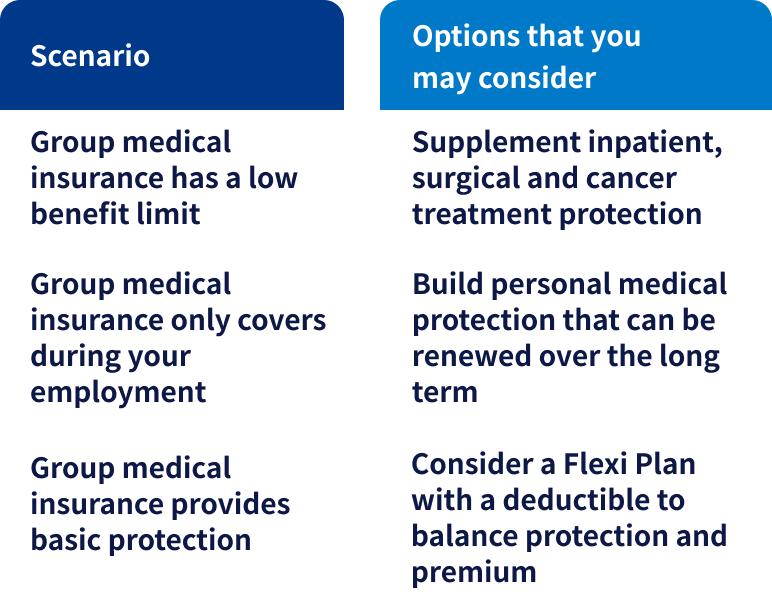
Many employees are covered by group medical insurance plans provided by their employers, so they may feel that individual medical insurance is unnecessary. However, group medical insurance is usually tied to your employment. If you change jobs, leave your company or retire, the coverage may not continue.

Consumer Council recommends that before purchasing or switching to VHIS, consumers should first review whether their existing medical protection is sufficient. This includes any individual medical insurance purchased in earlier years, group medical insurance provided by their own employers or their spouse's employers, and whether such coverage can continue after they leave their employment or retire.

If you are already covered by a group medical insurance plan, VHIS may serve as a "second layer" of protection:

Group medical insurance scenarios and VHIS as a second layer

5.How Much Can You Save Through Tax Deduction?
Do Not Buy Solely for Tax Reasons

Tax deduction is one of the appealing features of VHIS, but it is important to understand how it works. HK$8,000 is the maximum deductible premium amount — it is not a direct HK$8,000 reduction in the tax payable.

According to government information, the deductible amount for each insured person is the lower of the actual qualifying premium paid or the specified maximum deduction. From the 2020/21 year of assessment onwards, the maximum deductible is HK$8,000.

A simple formula:

Tax saved = Qualifying premium deduction × Applicable tax rate

For example, if your applicable tax rate is 15% and the qualifying premium for an insured person reaches HK$8,000, the estimated tax saving would be:

HK$8,000 × 15% = HK$1,200

That said, Consumer Council has reminded consumers not to purchase or transfer a policy purely for tax deduction. You should compare the protection, premium and long-term affordability before making a decision2,4.

Tax deduction calculation illustration

6.Do Not Just Look at This Year's Premium —
Consider the Next 10 or 20 Years

Medical insurance is usually a long-term commitment. Premiums may change with age, medical cost inflation and product pricing. The official VHIS website reminds consumers that standard premiums for Standard Plans and Flexi Plans are usually determined by age and may be adjusted at the time of renewal. Consumers should therefore consider medical insurance as long-term protection instead of looking only at the premium at their current age.

If a first-year discount is available, pay close attention to the difference between the discounted premium and the standard premium. Consumer Council has noted that many premium discounts are short-term or time-limited offers. Before applying, you should assess whether you can afford the premium at the time of renewal when the discount no longer applies.

Before applying, consider these three figures:

  1. Premium at your current age
  2. Premium around retirement age
  3. Premium at older ages
Long-term premium planning illustration

7.Pay Attention to Existing Conditions,
Unknown Pre-existing Conditions and Waiting Periods

One important feature of VHIS is that it covers "unknown pre-existing conditions" at the time of application, although the level of coverage usually increases gradually over time. In general, unknown pre-existing conditions are not covered in the first policy year. The reimbursement percentage increases in the second and third policy years, and full coverage may apply from the fourth policy year onwards, subject to policy terms.

However, if a condition is already known at the time of application, the insurer may require underwriting, impose exclusions, charge an additional premium, or even decline the application. Consumer Council advises consumers to disclose the requested information and medical history truthfully when applying, as omissions or non-disclosure may affect future protection.

Before applying, pay particular attention to:

  • Is there a waiting period?
  • Will known medical conditions be excluded?
  • How does coverage for unknown pre-existing conditions increase over time?
  • Will switching policies require new underwriting?
Pre-existing conditions and waiting period illustration

8.Private Healthcare Pricing May Not Always Be Transparent —
Ask About Costs Before Making a Claim

Having medical insurance does not mean you can ignore medical costs altogether. The Consumer Council study pointed out several issues in private healthcare price transparency, including insufficient price information, unclear mechanisms for doctors' fees and hospital charges, inadequate written estimates, and differences between estimated and final bills.

The study also noted that from 2021 to 2024, Consumer Council received 191 complaints relating to private hospitals and day care centres, of which 45.5% involved fee disputes1.

Therefore, even if you already have VHIS coverage, before seeking treatment it is advisable to:

  • Request a written quotation or estimate from the hospital;
  • Check whether doctors' ward round fees, anaesthetist's fees and operation theatre fees are included;
  • Confirm whether your insurer offers pre-authorisation or cashless arrangements.
Enquiring about private healthcare charges

VHIS Pre-application Checklist

Before applying, use the following 10 questions to check whether you are heading in the right direction:

  • Do I know whether I need a Standard Plan or a Flexi Plan?
  • Do I understand the policy's annual benefit limit and itemised benefit limits?
  • Do I understand how deductibles work?
  • Have I compared premiums at future ages instead of looking only at the first-year offer?
  • Do I know whether my employer-provided medical insurance will continue after I leave my job?
  • Have I calculated my actual premium cost after tax deduction?
  • Have I declared my health condition and medical history truthfully?
  • Do I understand how pre-existing conditions will be handled?
  • Do I know what documents are required for claims?
  • Have I set aside emergency funds for deductibles or expenses that may not be fully reimbursed?

If you have any questions about VHIS, please contact our Health Management Advisors.

Frequently Asked Questions

VHIS is a government-certified individual indemnity hospital insurance product. Standard Plans must meet minimum product requirements, including standardised protection, guaranteed renewal up to a specified age, no lifetime benefit limit, and coverage for unknown pre-existing conditions at the time of application. Ordinary medical insurance may not necessarily meet VHIS requirements and may not be eligible for tax deduction.

The maximum qualifying premium deduction is HK$8,000 per insured person each year. The actual tax saving depends on your applicable tax rate. It is not a direct HK$8,000 reduction in tax payable.

It depends on the benefit limit, scope of coverage, whether family members are covered, and whether the protection can continue after you leave your job or retire. Consumer Council recommends reviewing whether your existing medical protection is sufficient and whether you can afford the additional premium before applying.

If you want basic inpatient protection and easier premium comparison, a Standard Plan may be more straightforward. If you prefer higher benefit limits, broader protection, or full-cover options, you may compare different Flexi Plans. According to official VHIS information, Flexi Plans must maintain the overall protection of Standard Plans while offering higher levels of coverage.

Conclusion: When Buying VHIS, the Key Question Is Not Just "Can I Claim Tax Deduction?" — It Is "Is the Coverage Enough?"

VHIS can be part of your medical protection and tax planning. However, the real comparison should go beyond premium levels. You should also consider benefit limits, deductibles, claims arrangements, renewability, treatment of pre-existing conditions and long-term premium affordability.

Before buying, start with your own healthcare needs. Do you want access to private hospitals? Do you already have employer-provided medical insurance? Do you need to protect family members? What level of deductible can you afford? From there, you can work backwards to decide whether a Standard Plan or Flexi Plan is more suitable. This approach is more practical than simply looking for the lowest premium or the highest tax deduction.

Remarks

The above information is based on market product data as at January 2026 and is for reference only. This material is written and published by Bupa. To the best of the relevant persons' knowledge, the information is recent and has been prepared based on reliable sources. However, Bupa (Asia) Limited and all companies within the Bupa Group ("Bupa Group") make no representation or warranty as to the completeness or accuracy of the content. Bupa Group shall not be liable for any loss or damage suffered by any person arising from the use of or reliance on the information on this page. Nothing on this page constitutes any promise, guarantee, admission or waiver of liability by Bupa (Asia) Limited in relation to claims. Whether a Bupa member (insured person) is ultimately eligible for a claim depends on the scope of coverage under that member's insurance policy. Third-party websites referred to on this page are not written, owned or controlled by Bupa Group. Such websites may be accessed and information may be posted there by any person. Bupa Group is not responsible for the content of, or access to, such third-party websites.

1 https://www.legco.gov.hk/yr2025/chinese/fc/fc/w_q/hhb-c.pdf (Number of VHIS certified product policies reached approximately 1.341 million)

2 Confidence and Value: Enhancing Healthcare Price Transparency (Inpatient haemorrhoidectomy charges ranged from HK$33,881 to HK$85,387, representing a difference of 152%)

3 Information is taken from hospital official websites. Fees and charges are for reference only (updated as at ). Please contact the relevant hospitals for details.

4 Tax Deduction for Voluntary Health Insurance Scheme (Examples of tax deductions for policyholders and taxpayers)

Conclusion illustration
Cookies help us provide you with the best Bupa experience We use cookies to analyse our website performance, to enhance and customise content and for advertising purposes. Please click “Acknowledge” to accept our use of cookies. To find out more please click Cookies Policy for details.
Acknowledge